







Municipal & Industrial Water Wastewater Processing Solutions - Transmitters, Gauges, Diaphragm Seals
If you are viewing on a smaller screen or with screen zoom, please use the horizontal scroll bar at the bottom of this table to see all information.
| TYPE | 05 | 160 psi maximum pressure | ||||
| INSTRUMENT CONNECTION SIZES | 02 | 1/4" NPT | 04 | 1/2" NPT | ||
| UPPER HOUSING MATERIAL | PP | PP | ||||
| DIAPHRAGM MATERIAL | E | EPDM-PTFE coated on process side | ||||
| PROCESS CONNECTION SIZES | 02 | 1/4" NPT* | 04 | 1/2" NPT | ||
| LOWER HOUSING MATERIALS | PV | PVC | PP | PP | KN | PVDF |
* Only available with 1/4" NPT Instrument Connection

If you are viewing on a smaller screen or with screen zoom, please use the horizontal scroll bar at the bottom of this table to see all information.
| PRODUCT SPECIFICATIONS | ||||
| Seal type | Threaded with non-replaceable diaphragm | |||
| Instruments | Type | Size | Minimum Pressure | Maximum Pressure |
| Gauges | 2-1/2" to 6" | 0 psig to 30 psig | 0 psig to 160 psig | |
| Transducers | — | 0 psig to 30 psig | 0 psig to 160 psig | |
| Switches | — | 0 psig to 30 psig | 0 psig to 160 psig | |
| Upper housing | Type | Non-continuous duty | ||
| Connections | 1/4" NPT, 1/2" NPT | |||
| Materials | PP, fiberglass reinforced | |||
| Diaphragm | Size | 1.77" | ||
| Displacement | 8.9 ml | |||
| Materials | EPDM, PTFE-coated | |||
| Lower housing | Connections | 1/4" NPT or 1/2" NPT | ||
| Materials | PVC, PP or PVDF | |||
| Operating temperature | Operating temperature is determined by the temperature/pressure configuration. See Pressure/Temperature Diagram. | |||

WARNING: This product can expose you to chemicals including Nickel, which is known to the State of California to cause cancer and birth defects or other reproductive harm. For more information go to www.P65Warnings.ca.gov
* Not recommended for use in vacuum applications.
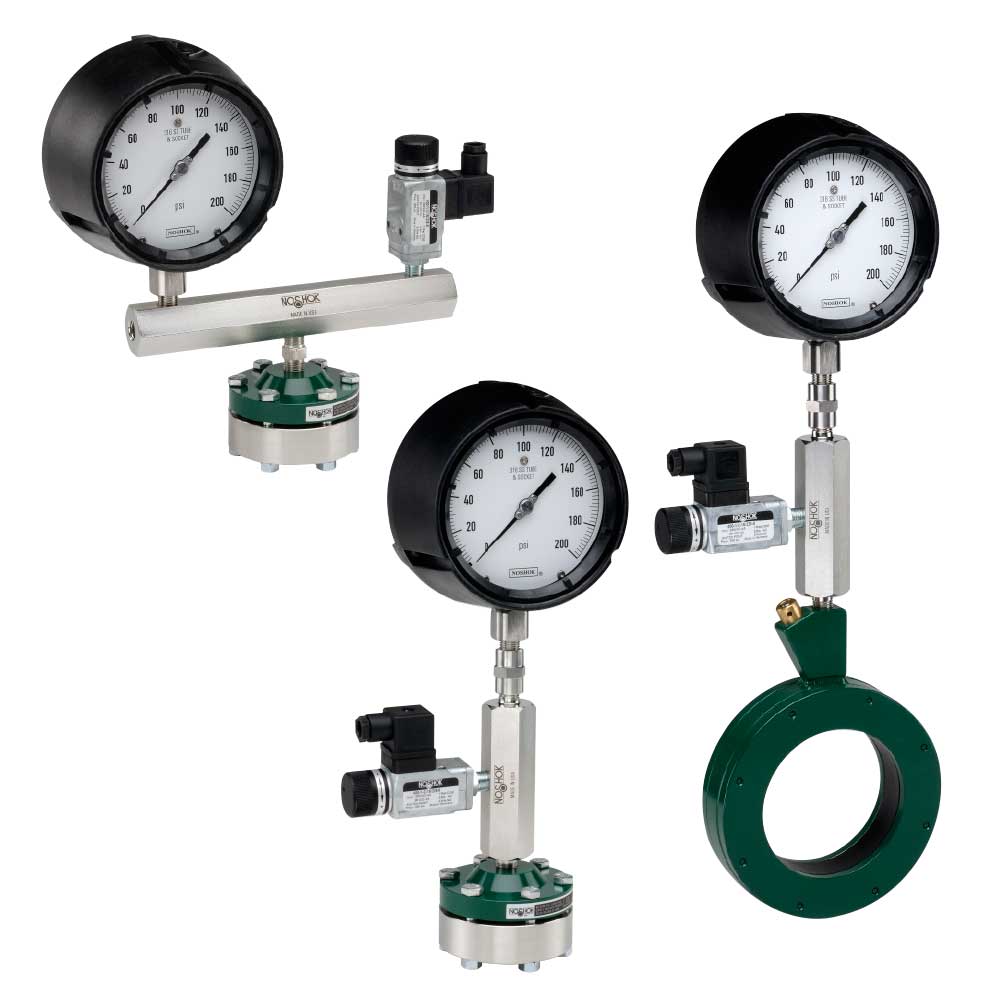
NOSHOK's Distribution Manifolds connect multiple instruments to one diaphragm seal, eliminating multiple connections that lead to possible leak paths.
View NOSHOK Distribution Manifolds
WARNING: This product can expose you to chemicals including Lead, which is known to the State of California to cause cancer and birth defects or other reproductive harm. For more information go to www.P65Warnings.ca.gov
WARNING: This product can expose you to chemicals including Nickel, which is known to the State of California to cause cancer and birth defects or other reproductive harm. For more information go to www.P65Warnings.ca.gov
The NOSHOK All Non-Metallic Diaphragm Seal & Pressure Transmitter/Switch assembly is ideal for water, wastewater & chemical feed applications.
View NOSHOK All Non-Metallic Diaphragm Seal & Pressure Transmitter/Switch assembly
WARNING:This product can expose you to chemicals including Lead and Nickel, which are known to the State of California to cause cancer and birth defects or other reproductive harm. For more information go to www.P65Warnings.ca.gov
A: Utilizing diaphragm seals with instruments is recommended when instrumentation is to be used in corrosive process media or extreme temperature media environments. Important factors to consider when selecting the correct diaphragm seal for a specific application include the instrument's location, the instrument's process connection size and type, process pressure and temperature limits, and any nontechnical fill fluid limitations such as nontoxic fill fluids for sanitary applications.
A: Process media compatibility is a key factor to consider when selecting a diaphragm seal fill fluid. Process media temperature should also be taken into account as all fill fluids expand or contract with temperature variations. The fill fluid viscosity and density are directly related to the measurement response time; the more viscous the fill fluid, the longer the response time, and a higher density fill fluid may affect mounting as well. Common diaphragm seal fill fluids include glycerin, silicone oils and halocarbon, but NOSHOK offers many more options including Neobee M20, mineral oil and propylene glycol for specialized applications. Glycerin should not be used for vacuum and compound gauges, or where a capillary is used between the instrument and diaphragm seal.
A: A diaphragm seal is designed to provide protection from corrosive, viscous, contaminated or very high temperature process media to valuable instrumentation. The pressure measuring element of the measuring device and the instrument connection port are filled with a suitable liquid using vacuum filling technology, making pressure measurement a direct and simple process. Pressure, when applied to the surface of the diaphragm, causes a pressure increase in the fill fluid which is then transferred to the attached pressure gauge, transducer, switch or other pressure measuring instrument.
A: Diaphragm seals can be used with pressure gauges, pressure transducers and transmitters, and electronic pressure switches.
A: Cooling elements work in combination with diaphragm seals to isolate the instrument from high media temperatures and are recommended for process temperatures above 212 ∞F. They provide effective temperature reductions of up to 200 ∞F depending upon ambient conditions and require a direct mounted system. Stainless steel capillaries with or without stainless steel armor can be used to protect the instrument from high or low process temperatures and allow remote mounting of pressure instruments; the shortest practical capillary length should be selected, as changes in ambient temperature conditions may significantly affect accuracy and response time. Sanitary clamps and gaskets for the NOSHOK Type 12 seal are available in NBR, EPDM, PTFE and FKM and meet FDA and 3A sanitary standards.
A: In general, the diaphragm adds approximately one-half percent to the instrument error at room temperature. There are also additional thermal errors that need to be calculated depending on the application. NOSHOK provides a thermal error calculation document to support these calculations, such as the Diaphragm Seal Thermal Error Calculations PDF available on the NOSHOK website.
A: The fill fluid pressure is equal to the application pressure. If a diaphragm bursts, the fill fluid will be dispersed into the process media and the instrument will be subjected directly to the pressure of the process media.
A:
Flush diaphragms eliminate dead legs where product can stagnate, which improves cleanability and reduces contamination risk. In balance tanks, compact flush-diaphragm transmitters with fast temperature compensation also give rapid, stable readings that help prevent overflows and low-level trips.
A: Sodium hypochlorite is highly corrosive to many metals, so a PTFE- or polymer-based diaphragm seal isolates the instrument from attack while maintaining accurate pressure transmission. NOSHOK's all non-metallic Type 5 diaphragm seal provides a corrosion-resistant, proven solution for hypochlorite and other aggressive disinfectants.
A: Flow-through annular seals let the process media pass through a sleeve-style diaphragm, isolating the instrument from plugging while still transmitting pressure. In sludge, slurry, and polymer service, NOSHOK flow-through seals keep sensing elements clean and responsive, extending maintenance intervals and improving pump protection and process visibility.
A: Application-focused assemblies - such as non-metallic seal/transmitter packages for chemical feed or distribution manifolds feeding multiple instruments from a single diaphragm seal - create repeatable building blocks you can deploy plant-wide. This approach simplifies design and maintenance, reduces leak paths and configuration variants, and ensures consistent performance from chemical rooms and pump stations to digesters, filters, and reservoirs.
A: Flush diaphragms are essential in food and beverage processing because they minimize ledges, pockets, and dead spaces where product can collect, spoil, or interfere with cleaning, while also helping prevent contaminant and moisture ingress at the process connection. They are especially important in viscous, sticky, or high-value products because they improve cleanability, reduce buildup, limit ingress risks, and maintain measurement accuracy during both production and CIP/SIP cycles.
A: Diaphragm seals protect pressure instruments by isolating them from aggressive, viscous, or clogging media such as paints, coatings, adhesives, and slurries commonly found in automotive processes. This prevents material buildup and plugging in processes with viscous or coating media, while also helping to reduce corrosion and wear on the instrument. They also support reliable pressure measurement in applications with elevated temperatures or challenging process conditions by allowing the use of appropriate fill fluids and capillary configurations.