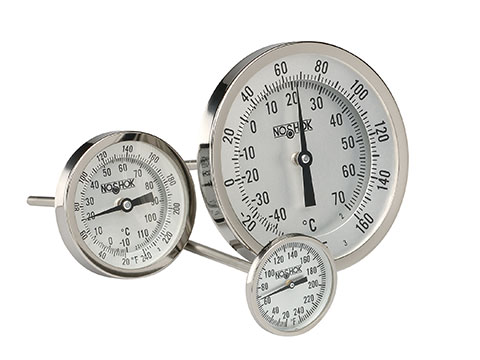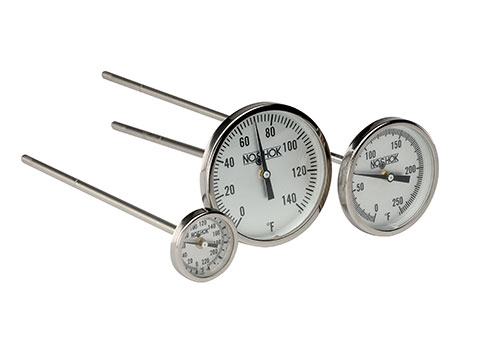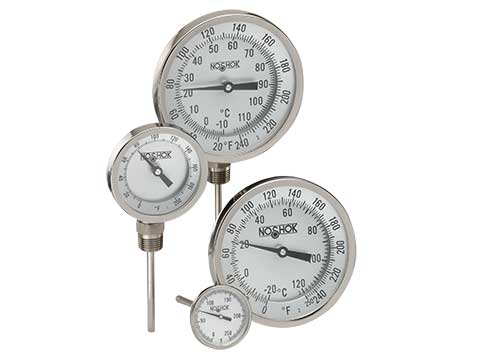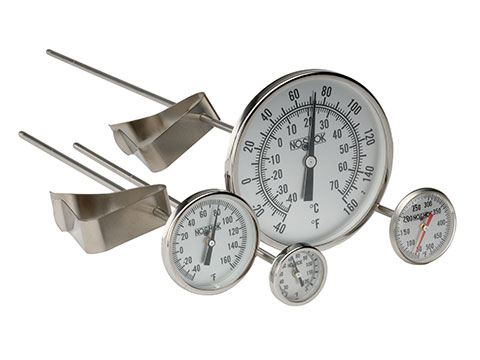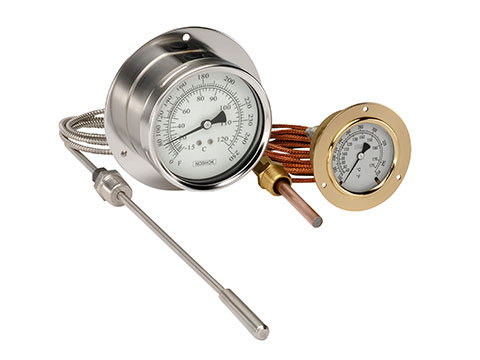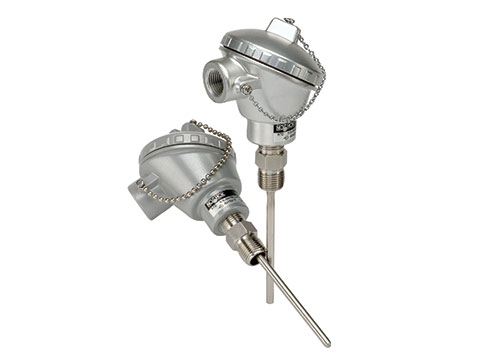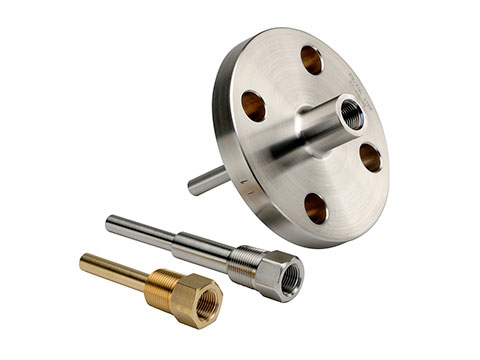








NOSHOK’s Temperature Measurement Solutions include bimetal thermometers, vapor actuated remote thermometers, digital temperature indicators, probe type RTDs, RTD transmitters, temperature transmitters & switches, and thermowells. We also offer a variety of options and accessories such as stem types, connections, special dials and lenses, certified calibration and RTD terminal blocks.
NOSHOK has re-engineered and expanded our Bimetal Thermometer offering, with cost reductions of up to 28% and significantly improved delivery times of 5-7 days. NOSHOK Bimetal Thermometers feature a 360° groove around the stem to provide a visual reference to show the minimum immersion point, and anti-parallax dial on all 3” and 5” dial sizes makes it easier to read from multiple angles. Our electronic temperature measuring instruments are ideal for pharmaceutical, food preparation, utilities and municipal, refineries, chemical and petrochemical plants, paper mills and hydraulic applications, and include hazardous environment approved RTDs.
NOSHOK thermowells are recommended for pressure, corrosive fluids and high velocity applications.

Why Choose NOSHOK Temperature Measurement Solutions?
A: Maximum temperature for a bi-metal thermometer in continuous use is 800 ∞F but it can be used in applications intermittently up to 1000 ∞F.
A: RTDs, or resistance temperature devices, are temperature sensors that are commonly used in a variety of industrial applications including industrial boilers, petrochemical, exhaust gas monitoring and food processing. RTD sensors have a higher accuracy than thermocouples and thermistors over a wide temperature range, and are more stable over time. Simply put, an RTD is a sensor whose resistance changes with temperature in a consistent repeatable manner.
A: An RTD can provide highly accurate and consistent temperature measurements because the change in resistance of certain materials is so predictable. Most RTD sensors have a response time between 0.5 to 5 seconds and commonly feature a platinum-based element, but can also be constructed with nickel or copper. RTDs made with platinum, also known as PRTs or platinum resistance thermometers, are used most often today due to their higher temperature capabilities, better stability and repeatability. Probe type RTDs generally consist of a rigid probe with direct mounted connector or extension cable. Assembly type models usually incorporate a rigid probe assembled with a connection head or junction box. Direct immersion probes have the RTD protective sheath, the probe, welded to a process fitting similar to temperature gauges, which offers better response but limited mechanical protection and limited access to a process under operation. Assemblies for thermowells have the RTD probe typically spring loaded in the connection fitting, which ensures good thermal contact and removes dead space in the well tip.
A: An RTD connection head provides a clean, protected area for mounting a terminal block or transmitter, and can be rated for indoor or outdoor use, providing protection against dust, rain, splashing and water from washdown hoses. NOSHOK RTD connection heads are available in cast aluminum, white polypropylene and cast 316 stainless steel. White polypropylene is popular for sanitary and chemical applications, while stainless steel is often used in food, pharmaceutical, biotech and chemical applications. Aluminum and stainless steel are preferred for industrial applications. Intrinsically safe explosion-proof enclosures are also available for hazardous environments.
A: The physical principles of vapor actuation require that the dial face be printed with a nonlinear, progressively graduated temperature scale. These instruments are available for direct mounting, or for remote mounting with capillary lengths up to 100 feet. Sensing bulb length is dependent upon the capillary length selected; a longer capillary length will require a longer sensing bulb length.
A: A thermowell would offer additional protection and is the preferred method if the application allows for one to be installed.
A: The sliding compression fitting can be used to adjust the immersion depth of the instrument's stem. The adjustable union connection can be used to reposition the dial face for better viewing.
A: A thermowell is used with a temperature-sensing instrument to provide a protective barrier between the instrument and the process media. Thermowells can provide protection from harmful process influences including flow, high pressure and harsh environments, reducing the possibility of damage to the temperature instrument and providing protection to the operator. Thermowells also allow easier service to the instrument and reduce operating costs by allowing the temperature instrument to be removed and replaced without shutting down and draining the process.
A: The most commonly used types of thermowells are threaded, socket weld, weld-in and flanged connections. A threaded thermowell is screwed directly into the process through the tapped pipe wall or via a thermowell threadolet. Socket weld thermowells can be welded directly into the socket of the weldolet or into the wall of the pipe. Weld-in thermowells are welded directly into the piping or a process vessel. Flanged thermowells incorporate a flange collar located on the mating flange, which is paired with a pipe nozzle.
A: A lagging extension, often referred to as the thermowell's T length, is located on the cold side of the process connection and is usually an extension of the hex length of the thermowell. The lagging extension enables the probe and thermowell to extend through insulation or walls.
A: The bore depth S of a thermowell can be used as a reference for the maximum stem length. The S must equal or exceed the length of the sensitive portion of the instrument's stem.
A: UHT systems rely on precise pressure and temperature measurement across heaters, coolers, product lines, and hold sections to maintain the correct thermal profile and protect product quality. Sanitary transmitters, temperature transmitters, and local thermometers all play a role in verifying that the process achieves microbial safety while limiting flavor damage, fouling, and thermal overstress.