A New Year of Solutions
 2026 marks the next phase in NOSHOK’s evolution - one defined by expansion, innovation, and partnership.
As your trusted Measurement Solutions partner, we’re broadening what it means to deliver reliability, ruggedness, and precision across the industries we serve.
From advanced pressure, level, and temperature instrumentation to our latest valve technologies, this year brings an exciting lineup of new product launches designed to meet the demands of more applications and markets than ever before. You’ll also see a growing library of in-depth videos, application spotlights, and quick-hit technical shorts - all created to help engineers, OEMs, and operators solve real-world challenges faster and smarter.
Whether you’re focused on fluid power, process automation, food & beverage, oil and gas, water and wastewater, power generation, or the rapidly expanding data center sector, NOSHOK is evolving to meet your needs with solutions engineered for safety, efficiency, and long-term reliability.
Stay tuned for our first 2026 product release and video announcement - coming soon! Follow NOSHOK on LinkedIn, Facebook, X and YouTube for first looks, behind-the-scenes engineering insights, and practical how-to content throughout the year.
Product Focus
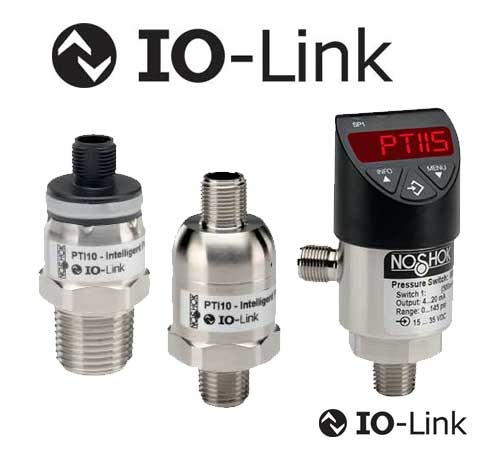
PTI10 & PTI15 Intelligent Pressure Transmitters with IO-Link
NOSHOK is excited to introduce the newest additions to NOSHOK’s proven PTI Series - the PTI10 and PTI15 Intelligent Pressure Transmitter and Transmitter/Switch with IO-Link communication. These transmitters combine advanced digital connectivity with the performance, reliability and durability you’ve come to expect from NOSHOK instrumentation.
IO-Link technology opens the door to smarter integration across your automation and process networks.
With bidirectional digital communication, the PTI10 and PTI15 deliver simplified installation, remote configuration, continuous diagnostics, and enhanced data transparency - optimizing uptime and streamlining system integration.
Built on the trusted foundation of NOSHOK’s PTI Series, these transmitters feature:
- Highly accurate and repeatable pressure measurement across a wide range of industrial applications
- Robust Stainless Steel construction to ensure long-term stability in demanding environments
- Compact, rugged design for flexible installation even in space-limited systems
The PTI10 and PTI15 are ideal for smart factory environments, OEM equipment, and process automation systems where real-time process visibility and predictive maintenance capabilities are key.
As industry connectivity evolves, NOSHOK’s IO-Link-enabled transmitters help our partners and customers move confidently toward the next generation of intelligent measurement and control.
Pressure Gauge Product Updates
Two more exciting new announcements from NOSHOK!
NOSHOK is now offering more precision for specialized low-pressure applications.
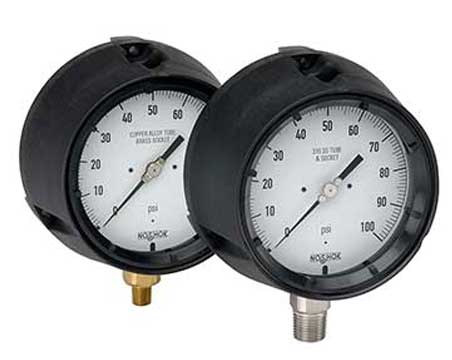
NOSHOK’s 600 & 700 Series Process Pressure Gauges are now available in multiple additional ranges, from extreme low-pressure 30 inH2O Vac to 100 inH2O, plus 0-5 psi and 0-10 psi.
NOSHOK 45-740 low pressure process gauges offer a safety version with a solid front design.
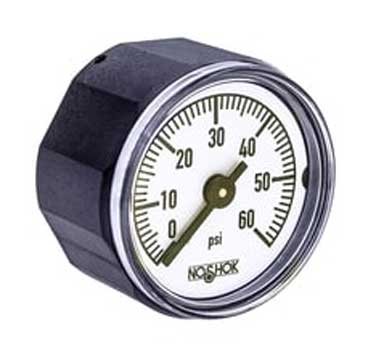
In addition, we are now offering a 1 inch version of our popular 100 Series Dry Pressure Gauges.
This miniature lightweight pressure gauge features a one-piece case and process connection design, making it more resistant to mechanical damage. This design is ideal for applications with compact equipment requiring built-in small pressure gauges, including gaseous and liquid media, pneumatics and compressors.
Front Flush Connection Now Available on PT Series Pressure Transmitters
The NOSHOK PT Series transmitter portfolio provides significant performance enhancements, increased options and availability – all at reduced pricing with improved delivery times.
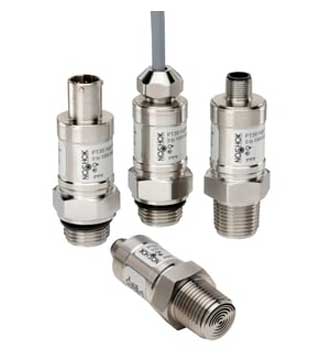
To further expand the options on our popular PT Series transmitter product line, we are now offering a front flush diaphragm process connection on our PT30 Series High Performance Fixed Range Transmitters & Transducers.
Our unique front flush design is engineered for universal compatibility, allowing for direct installation into the standard NPT or ISO 1179 ports common to industrial equipment and standard pipe fittings.
Benefits include:
- Welded front flush diaphragm construction prevents clogging and process material build-up
- Ideal for use with process medias that clog or solidify in standard process connection ports
- Configurable with an integrated cooling element that expands the media high temperature limit to 302 °F (150 °C)
Application Insight
IO-Link Basic Instrumentation
IO‑Link is a standardized digital point‑to‑point interface that connects smart sensors and actuators to an IO‑Link master, enabling richer data, easier setup, and simplified replacement compared to traditional analog or discrete wiring.
It is not a fieldbus, but an evolution of the classic 3‑wire sensor connection that adds bidirectional communication, diagnostics, and parameterization capabilities.
What is IO-Link?
- IO‑Link is a globally standardized I/O technology (IEC 61131‑9) for communication between sensors/actuators and controllers
- It uses a serial, bi‑directional, point‑to‑point connection over standard 3‑wire cables to transmit process data, parameters, and diagnostics
- An IO‑Link system consists of IO‑Link devices (sensors/actuators) and at least one IO‑Link master connected to a PLC or industrial Ethernet network
Why use IO-Link with instrumentation?
- Improved data access: In addition to the primary measurement (pressure, level, temperature, flow, etc.), IO‑Link devices can provide status, events, and extended diagnostics for smarter condition monitoring
- Simplified commissioning: Parameters such as measuring range, units, switch points, and damping can be set centrally from the controller or engineering tool, reducing setup time on the machine
- Easier maintenance: Device parameters can be stored in the IO‑Link master and automatically downloaded to a replacement sensor, minimizing downtime and manual reconfiguration
How does IO-Link wiring differ from analog?
- IO‑Link uses unshielded 3‑conductor standard sensor cables instead of specialized analog or fieldbus cabling, often allowing reuse of existing wiring
- Each IO‑Link master port connects to exactly one IO‑Link device in a point‑to‑point manner, and the same port can often be used in standard I/O (SIO) mode for simple on/off signals when IO‑Link is not active.
- Digital communication is less susceptible to electrical noise than analog signals, which helps maintain measurement accuracy over longer cable runs
What data can IO-Link instrument provide?
- Cyclic process data, such as live measurement values, switching states, and device status bits, is transmitted continuously each cycle
- Acyclic service data includes configuration parameters, device identification, and diagnostic/event information, which can be read or written on demand
- Many IO‑Link devices support multiple process variables and rich diagnostics, enabling advanced applications like predictive maintenance and detailed trend logging
What is needed to use IO-Link?
- An IO‑Link‑capable sensor or instrument connected to an IO‑Link master port using a standard 3‑wire sensor cable
- An IO‑Link master module or block that links the IO‑Link ports to a PLC or industrial Ethernet network such as PROFINET, EtherNet/IP, or similar
- Engineering or configuration software (for example, vendor IO‑Link parameter tools or PLC engineering tools) to access parameters, diagnostics, and device descriptions (IODD files) for commissioning and service
NOSHOK News
New Vice President - Business Development
NOSHOK is pleased to welcome Brandon Guse as our new Vice President of Business Development. With extensive leadership experience in manufacturing and distribution, Brandon has successfully built high-performing teams, driven national sales strategies, and delivered measurable growth for leading industrial brands.
In this role, Brandon will lead NOSHOK’s business development initiatives, focusing on expanding partnerships, strengthening relationships across key industrial segments, and driving innovation aligned with NOSHOK’s commitment to superior value and performance.
“Brandon’s deep industry expertise and strategic vision make him an outstanding addition to the NOSHOK executive team,” said Christian Cole, CEO/President of NOSHOK. “We’re excited to welcome him as we continue to grow and strengthen our partnerships.”
Quick Online RMA Access
NOSHOK makes it exceptionally easy to do business with through its streamlined Return Material Authorization (RMA) process, designed for efficiency and partner convenience.
Customers, distributors, and partners can quickly request an RMA online via a simple, self-serve form - no phone calls or faxes required - by filling out key fields like part details, quantity, and return reason, with required fields clearly marked for fast submission.
Upon review, NOSHOK emails the RMA acknowledgement with a unique number valid for 30 days, which must be displayed on the package along with a packing list, ensuring smooth freight-prepaid returns and minimizing delays. This self-serve feature empowers you to handle returns proactively, reducing hassle and supporting your operations with NOSHOK's commitment to responsive service.
Tech Tip
Q: What applications require the various lens materials, and to what maximum temperature can each be subjected?
A: Lens materials include Instrument Glass, Laminated Safety Glass, Tempered Glass, and plastic.
Glass lenses are used for abrasion, chemical and wear resistant properties.
Laminated safety glass reduces the possibility of shattering if the Bourdon tube ruptures. Tempered glass is 2 to 5 times stronger than plain glass.
Plastic lenses are used for impact, corrosion and chemical resistance. Special attention should be paid to the temperature and corrosive environments.
Polycarbonate is selected for its superior impact resistance, acrylic for its clarity and scratch resistance.
Homalite for its superior chemical resistance. In general, gauges with plastic lenses should remain below 140° F.

 Convert to PT Series
NEW
Convert to PT Series
NEW