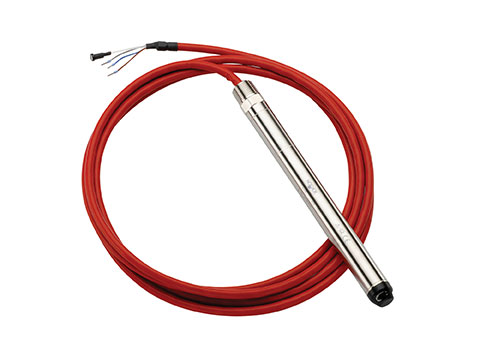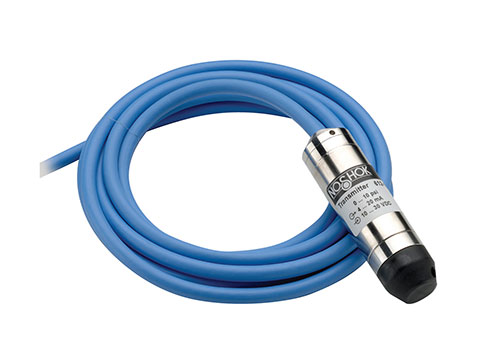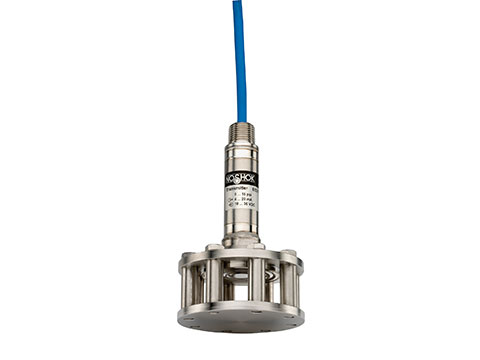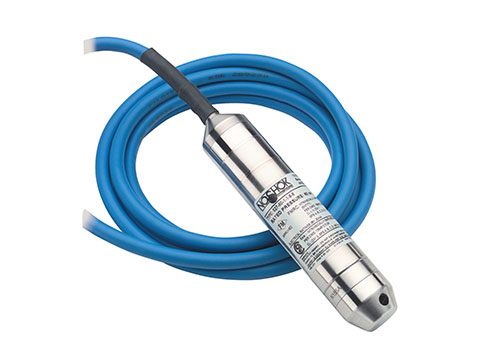








NOSHOK industrial submersible level transmitters are designed to withstand harsh applications. Our offering includes a small diameter (0.97") submersible level transmitter designed for hydrostatic level measurement for use in applications including bore holes and wells with small diameters. This sensor provides low power output signals for battery-powered applications, and an optional temperature output available. We also provide a cage-protected level transmitter ideal for harsh environments including sludge, slurries, tank monitoring, water & wastewater.
NOSHOK also offers an intrinsically safe submersible level transmitter for hazardous locations such as water, wastewater, and well head measurement.This sensor is FM, and CSA approved.
A:
A level transmitter provides a continuous signal - typically 4?20 mA or 4?20 mA with HART® protocol - that represents the entire usable range of the tank. A level switch is a discrete instrument that simply changes state at a defined point, which is ideal for alarms and pump start/stop functions.
A:
Submersible transmitters are a strong choice in wells, sumps, and lift stations where side or top nozzles are limited and level is best sensed from below. For harsh water and wastewater environments, a cage-protected design helps keep the sensing diaphragm safe from debris, slurry and sludge.
A:
Sanitary applications demand crevice-free wetted surfaces, hygienic connections, and materials that meet standards such as 3-A or ASME-BPE. NOSHOK offers intelligent tank and silo transmitters with polished 316L Stainless Steel housings which are engineered specifically for these hygienic requirements.
A:
During CIP and SIP, instruments are exposed to hot caustic solutions, steam, and rapid temperature swings, so seals, diaphragms, and electronics must be designed for repeated thermal cycling. Modern sanitary transmitters place pressure and temperature sensors directly behind a compact flush diaphragm to provide active temperature compensation and maintain accuracy through cleaning cycles.
A:
Flush diaphragms eliminate dead legs where product can stagnate, which improves cleanability and reduces contamination risk. In balance tanks, compact flush-diaphragm transmitters with fast temperature compensation also give rapid, stable readings that help prevent overflows and low-level trips.
A:
Using standardized Tri-Clamp or ASME-BPE clamp connections allows instruments to be swapped without adaptors, simplifying maintenance, cleaning validation, and compliance documentation. NOSHOK sanitary transmitters are offered with a broad range of hygienic clamp and spud-style connections, so they integrate easily into existing food, beverage, and dairy vessels with no adaptors required.
A:
For suction protection, place a point level device just above the minimum safe liquid height and use a continuous transmitter to control normal start/stop levels. For transfer or filling applications, a high level switch near the top of the vessel provides a hard overfill limit that backs up the continuous level signal.
A:
HART® is a digital communication signal superimposed on the 4?20 mA loop, allowing you to remotely range, trim, and diagnose transmitters over the same two wires. Level and pressure devices often offer optional HART®, which lets you access extended configuration and status information without removing the instrument from service.
A:
A transmitter with a 10:1 turndown can be configured for a wide variety of spans, so one model can cover several tank heights or product densities. Intelligent sanitary transmitters use this capability to reduce spare-parts inventory while still maintaining accuracy on the adjusted span.
A:
A rotatable, backlit display allows operators to instantly read process variables (like tank volume, height, or percentage) and configure device settings in the field, even in tight installations.
A:
A cage-protected version surrounds the sensing diaphragm with a perforated guard, deflecting rocks, rags, and heavy solids while still allowing pressure transmission. This style is particularly well suited for sludge tanks, storm canals, and municipal lift stations where unprotected sensors can be easily damaged.
A:
In classified hazardous locations such as wellheads, digesters, or solvent storage, intrinsic safety ensures that the energy in the instrument circuit cannot ignite a flammable atmosphere. NOSHOK offers submersible and head-mounted transmitters that have approvals like FM and CSA to meet these requirements.
A:
When a device's stated accuracy is tied to the adjusted span rather than full scale, you retain high accuracy even after narrowing the range in the field. This is especially beneficial in food and beverage tanks where working levels may be only a fraction of the sensor's maximum rating.
A:
Corrosion resistant materials such as 316/316L stainless steel, PVDF, PUR cables, and Hastelloy C-276 wetted parts help level instruments survive aggressive or high chloride media, preventing stress cracking and corrosion over time. Choosing the appropriate wetted materials up front is critical for minimizing downtime and avoiding premature diaphragm or cable failures in harsh oil and gas, chemical, and water/wastewater environments. In sanitary food and beverage applications, NOSHOK level and pressure transmitters use 316L stainless steel wetted parts with polished, crevice free surfaces that meet 3-A requirements and are fully compatible with CIP/SIP cleaning.
A:
By continuously measuring process temperature at the diaphragm and applying compensation in real time, the transmitter minimizes temperature-induced errors in the sensor and fill fluid. This technology keeps readings stable during CIP/SIP, batch heating, or cold-start conditions.
A:
In addition to level or pressure, a smart device can expose sensor temperature, error codes, configuration changes, and status flags such as signal saturation or over range. This information can be used to identify plugged impulse paths, empty tanks, or failing sensors before they cause process interruptions.
A:
Yes, in some applications you can mount a radar level instrument outside the tank, provided several conditions are met. With a non-contact radar, external mounting is feasible when the tank or container wall is made of a radar-transparent plastic and the wall thickness is within the limits recommended by the manufacturer.
A:
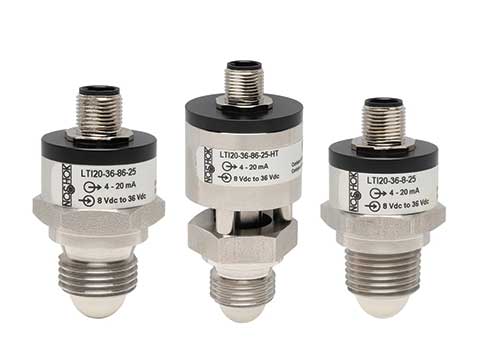
Yes, the LTI20 is designed for simple field calibration. Using the supplied magnet, you touch and hold it at the CAL label on the housing to initiate the calibration routine. This magnetic key method allows calibration without opening the housing, preserving the environmental seal.
A:
Hydrostatic transmitters are ideal for continuous level measurement in wells, lift stations, and tanks where the media is relatively clean. Vibrating fork switches are excellent for high or low point-level protection and pump run-dry protection when you need simple binary level alarms. Radar level transmitters provide continuous, non-contact level measurement that excels in applications with varying dielectric properties, agitation, or where you want to avoid any wetted sensor in the tank.
A:
Many plants choose a common platform of level and pressure transmitters with shared programming, displays, and communication options, then vary only connection type or range. This approach helps streamline training, commissioning, and spare-parts management.
A:
Level transmitters and switches ensure that a pump only operates when there is sufficient liquid present, preventing overheating, excessive wear, and potential cavitation caused by air ingestion. Early empty-pipe detection via continuous level monitoring or a point-level switch minimizes unplanned downtime and protects the pump.
A:
In food and beverage measurement, hygienic and sanitary are closely related but not always identical. Sanitary often implies conformity with specific regulations or standards such as 3-A or ASME-BPE clamp designs, while hygienic is a broader term describing designs that are cleanable, drainable, and resist product buildup. In practice, many engineers and OEMs use the terms interchangeably when referring to level and pressure instruments that feature polished stainless steel wetted surfaces, crevice free process connections, and CIP/SIP ready construction.
A: In high solids wet wells, the large, non-fouling sensing area and rugged cage of a NOSHOK 613 Series submersible level transmitter protect the diaphragm from debris and impact. This design provides stable, long-term level measurement in sewage, stormwater, and slurry environments where unprotected probes are prone to plugging and damage.
A: For large reservoirs and towers, NOSHOK non-contact radar level transmitters provide continuous level data without contacting the water, minimizing maintenance and contamination risk. Submersible transmitters can be used in wells and standpipes to track drawdown and recharge, supplying accurate data for storage management and distribution pressure control.
A: Sanitary level transmitters provide repeatable hydrostatic level measurement that helps processors accurately track inventory in storage tanks and silos, compare input versus throughput, and reduce product loss from overfills or poor visibility. When integrated into plant control and alarm systems, they also support automated responses that help prevent spills, waste, and unplanned downtime.
A: Direct-fit sanitary transmitters reduce retrofit complexity because they can match existing spud and shell connections without requiring adaptors or equipment changes to the vessel. That shortens installation time, reduces hygienic risk at the connection point, and makes it easier to standardize upgrades across mixed tank populations in a live production plant.
A: Insulated tanks require a measurement solution that keeps the sensing diaphragm flush with the product side while allowing the transmitter body to mount correctly outside the insulated wall. NOSHOK addresses this by having all the process connections that exist that are installed on insulated tanks. NOSHOK also offers KING-GAGE flush weld tank shells that are offered in different lengths to match single-wall and insulated tank constructions.
A: NOSHOK sanitary transmitters provide standard process-control outputs- most commonly 4–20 mA, with optional HART® digital communication- that wire directly into PLC analog input cards, remote I/O, or hybrid purge/level controllers. Once the PLC is reading the signal, those same tags are exposed to SCADA and MES for alarming, trending, inventory management, and batch/traceability functions in food & beverage plants. The 20, 25, and 30 Series sanitary transmitters are designed to simplify this integration: they offer easy range configuration via an onboard display (no reference pressure needed), turndown up to 10:1 with accuracy specified on adjusted span, and optional HART® for remote configuration and diagnostics over the same 4–20 mA loop. Their sanitary process connections (direct-fit to common tank shells and Tri-Clamp® fittings), active temperature compensation, and CIP/SIP-capable stainless construction ensure that the measurements feeding PLC/SCADA/MES reflect true process conditions while meeting modern food and dairy hygienic requirements.
A: By providing continuous level that incorporates active temperature compensation. This compensation detects whether the media is hot or cold, and enables the transmitter to adjust its level reading that is affected by the temperature. The pressure data is then sent to plant control systems, intelligent sanitary transmitters enable alarms, pump stop logic, and other automatic actions before a tank reaches an unsafe fill condition. This improves operator response time while protecting product, surrounding equipment, and sanitation conditions in the processing area.
A: Meeting the requirements for 3-A indicates that the instrument is designed for hygienic service, with features such as smooth wetted surfaces, cleanable geometries, and sanitary materials suitable for food, beverage, and dairy processing. For processors, that means the instrument is better aligned with hygienic design expectations for contamination prevention, cleanability, and repeatable sanitation performance.
A: Flush diaphragms are essential in food and beverage processing because they minimize ledges, pockets, and dead spaces where product can collect, spoil, or interfere with cleaning, while also helping prevent contaminant and moisture ingress at the process connection. They are especially important in viscous, sticky, or high-value products because they improve cleanability, reduce buildup, limit ingress risks, and maintain measurement accuracy during both production and CIP/SIP cycles.
A: Instruments that remain in place during CIP/SIP cycles must tolerate high temperatures, thermal shock, and caustic cleaning chemistry - cycle after cycle - without drifting, damaging seals, or compromising hygienic integrity. NOSHOK sanitary transmitters are engineered for these conditions with pressure and temperature sensors mounted directly behind the diaphragm, providing fast, active temperature compensation at the point of measurement so readings remain stable through hot cleaning transitions and recover quickly afterward. This rapid stabilization helps operators trust the data sooner after CIP/SIP, shortening restart times, improving process visibility during ramp-up, and reducing nuisance alarms or conservative manual interventions caused by slow sensor response.
A: Selecting the right materials of construction and surface finishes is critical because instrumentation sits directly in the product path and must withstand repeated exposure to food media, cleaning chemicals, and high temperatures without corroding, leaching, or trapping residue. Polished Stainless Steel housings and electropolished wetted surfaces, like those used on NOSHOK sanitary gauges and transmitters, enhance cleanability, reduce product retention and biofilm risk, resist corrosion in aggressive washdown environments, and help maintain hygienic integrity and measurement stability over many CIP/SIP cycles. NOSHOK also offers other diaphragm materials, such as Hastelloy C, that can combat caustic solutions that can are harmful to Stainless Steel.
A: In cheese brining, pressure, level, and temperature data help maintain stable brine depth, reliable circulation, proper salt uptake, and consistent cooling conditions. Accurate measurements also support automated control of pumps, valves, and chillers so cheese moves through the flume consistently without piling, stalling, or drifting outside the desired brining conditions.
A: HART® protocol combines a digital communication layer with the standard 4–20 mA signal, allowing processors to keep their familiar analog control architecture while adding remote configuration, diagnostics, and advanced setup capability. In practice, that supports faster commissioning, easier range changes, and better maintenance visibility across tanks, silos, and sanitary process lines.
A: High turndown lets one transmitter family cover multiple ranges and tank geometries, which helps reduce inventory and standardize instrumentation across a plant. Accuracy based on adjusted span is especially valuable because it maintains better measurement performance after the device is ranged for a specific vessel, instead of tying accuracy only to full-scale limits that may be much larger than the working process range.
A: Sanitary electronic pressure and level transmitters are the primary choice when you need high-accuracy, fully integrated measurement tied directly into PLCs and SCADA, especially on product-contact tanks and hygienic process lines where 3-A/ASME-BPE compliance, CIP/SIP capability, and active temperature compensation are critical. KING-GAGE pneumatic column indicators and bubbler-based systems, by contrast, remain a strong option for legacy infrastructure or where simplicity, safety, and remote measurement are top priorities-for example on utility or non-critical tanks, in harsh or classified areas, or wherever you want a non-electronic sensing point in the vessel with a pneumatic signal driving a local mechanical column indicator.
A: Marine level and draft instrumentation is used across a range of onboard tanks and measurement points, including ballast tanks, fuel-oil tanks, lube-oil tanks, service and day tanks, potable-water tanks, grey-water and sewage holding tanks, and bilge tanks, as well as draft monitoring at the bow and stern. These measurements support vessel stability, safe loading and unloading, equipment protection, environmental compliance, and efficient onboard operations through both continuous level monitoring and draft verification.
A: Ballast-tank level monitoring is essential for maintaining safe operating conditions, vessel trim and transverse stability throughout a voyage. Accurate ballast-level data also supports ballast-water management procedures and helps crews make informed loading and discharge decisions.
A: Draft measurement provides operators with continuous information about how deeply a vessel sits in the water at the bow and stern. This helps support safe navigation, loading compliance, trim optimization and fuel efficiency by ensuring the vessel is operating within intended draft limits.
A: Real-time tank-level monitoring gives operators immediate visibility into ballast, service and utility tank conditions without relying on manual soundings. This improves operational awareness, reduces time spent on routine checks and helps crews respond faster to abnormal tank conditions or alarm events.
A: Centralized tank indication allows operators to view multiple tank levels and draft conditions from a bridge, control room or engine room display. This simplifies vessel monitoring, improves response time and helps crews manage ballast, service fluids and stability conditions more efficiently.
A: Electronic level and draft systems provide continuous measured data directly to indicators and control interfaces, reducing the need for manual checks at each tank. This can improve crew safety by limiting access to confined or difficult-to-reach spaces while also saving time during routine operations.
A: Important factors include the type of liquid being measured, tank geometry, vessel motion, temperature variation, required indication points, alarm needs and compatibility with shipboard control systems. Environmental conditions such as vibration, moisture and corrosive atmospheres should also be considered.
A: Continuous tank-level monitoring helps prevent low-level conditions that could starve pumps, engines or generators of required fluids. It also helps avoid overfill situations, supports orderly transfer operations and improves overall visibility into onboard fluid management.
A: Tank-level and draft data provide the information needed to coordinate ballast adjustments, monitor cargo effects on trim and maintain vessel stability throughout loading and unloading operations. Reliable measurement helps operators make faster, better-informed decisions during changing operating conditions.
A: Yes. Modern marine measurement systems can provide signals to centralized displays, alarm panels and vessel management or automation systems. This supports more efficient monitoring, better recordkeeping and improved coordination across onboard systems.
A: Useful application details include the type of tank, liquid properties, tank dimensions, expected operating range, mounting location, alarm requirements, desired indication points and any needed integration with onboard control systems. Clear application information helps ensure the selected solution fits the vessel and operating environment.
A: Radar level measurement is non-contact and performs well on fluids that may be sticky, corrosive or produce vapors, such as paints and coatings. It is typically unaffected by changes in density, temperature or pressure, and it handles high-vibration environments, making it well suited for paint-shops, mix rooms and process-fluid reservoirs.
A: Submersible level transmitters are recommended for applications such as sumps, deep tanks, coolant reservoirs and process-water wells, where the device can be immersed directly in the liquid. They are widely used in engine and transmission test areas, wash-down systems and plant utilities to maintain correct levels and protect pumps from dry-run conditions.