Differential

Home » Products » Pressure & Level » Pressure Gauges » Differential » 1000 Series Piston Type Differential Pressure Gauges

1000 Series Piston Type Differential Pressure Gauges

REQUEST A QUOTE VIEW BY PART NUMBER
Download Literature
Oil & Gas
Water/
Wastewater
  • Simple, rugged, compact differential pressure gauge
  • Ranges from 0 psid to 5 psid through 0 psid to 110 psid
  • 2-1/2", 4-1/2" and 6" gauge sizes
  • Engineered plastic gauge case
  • Clear anodized Aluminum and 316 Stainless Steel wetted parts
  • Ideal for applications including back flow testing, heat exchangers, filter monitoring, flow indication and level indication

If you are viewing on a smaller screen or with screen zoom, please use the horizontal scroll bar at the bottom of this table to see all information.

GAUGE SIZES & SERIES 25-10 2-1/2" 45-10 4-1/2" 60-10 6"    
CONNECTION LOCATIONS 0 Bottom 1 Back 2 Side    
CONNECTION SIZE 2 1/4" NPT female 9 7/16-20 female (Back or side only)    
PRESSURE RANGES * P5 0 psid to 5 psid P20 0 psid to 20 psid P50 0 psid to 50 psid P100 0 psid psid to 100 psid
P10 0 psid to 10 psid P25 0 psid to 25 psid P60 0 psid to 60 psid P110 0 psid to 110 psid
P15 0 psid to 15 psid P30 0 psid to 30 psid P75 0 psid to 75 psid    
SENSOR HOUSING MATERIALS A Aluminum (3,000 max working pressure) S 316L Stainless steel (6,000 max working pressure)
O-RING MATERIALS 1 PTFE 3 NBR    
2 FKM 4 EPDM    
CASE MATERIAL A Aluminum (4-1/2"only) P Engineered plastic    
LENSES 1 Shatter-resistant acrylic 2 Safety glass ** 3 Maximum indicating pointer (MIP) ***
FILL FLUIDS (OPTIONAL) GY Glycerin SL Silicone        
SWITCH OR TRANSMITTER TYPE
& HOUSING
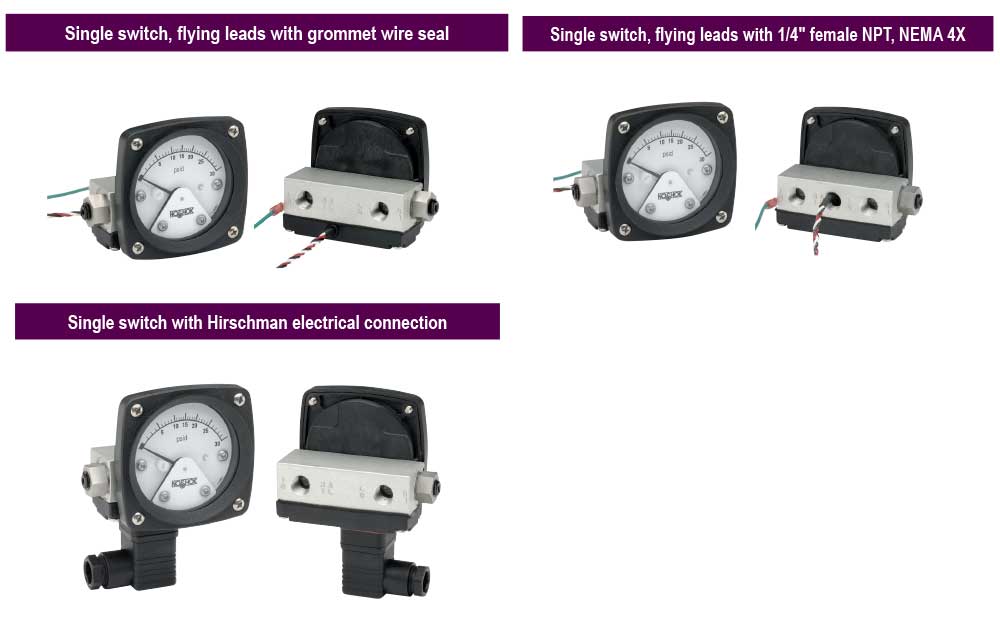
1 Single switch, flying leads with grommet wire seal 5 Single switch with Hirschman electrical connection
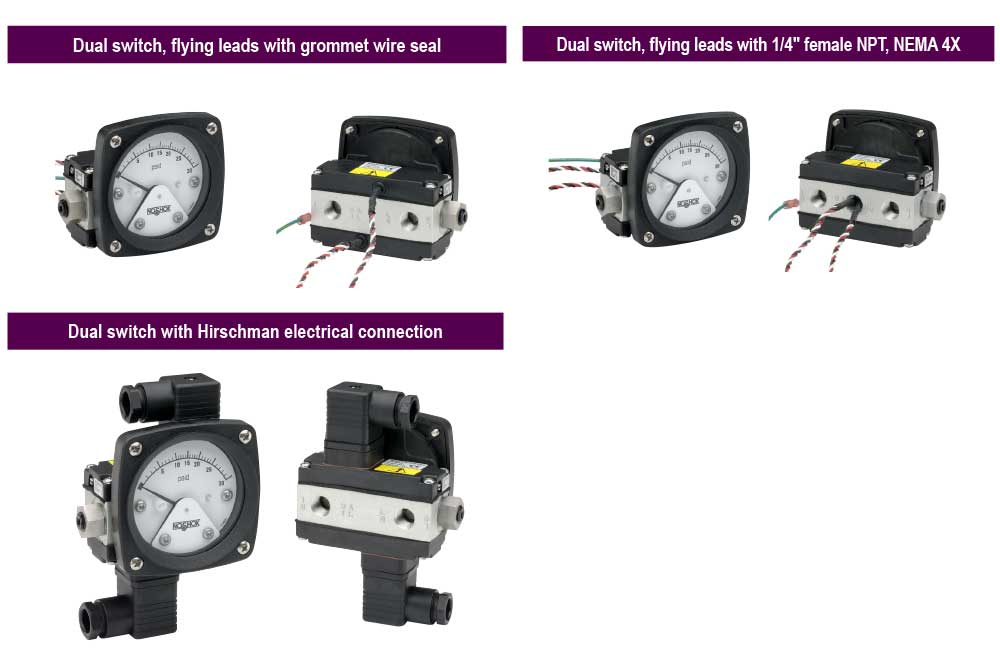
2 Dual switch, flying leads with grommet wire seal 6 Dual switch with Hirschman electrical connection
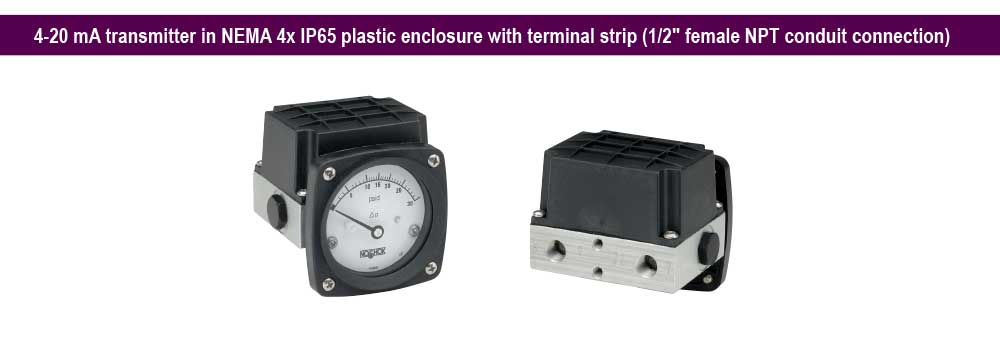
3 Single switch, flying leads with 1/4" female NPT, NEMA 4X 7 4-20 mA transmitter in NEMA 4x IP65 plastic enclosure with terminal strip (1/2" female NPT conduit connection).
4 Dual switch, flying leads with 1/4" female NPT, NEMA 4X
OPTIONS MH (2) 1/4-20 Mounting Holes RP Reversed Ports
MK5-CS Pipe Mounting Kit, Steel ST Stainless Steel Tagging
MK5-SS Pipe Mounting Kit, Stainless steel WMK Wall Mounting Kit

Please consult your local NOSHOK Distributor or NOSHOK, Inc. for availability and delivery information.

   Please consult your local NOSHOK Distributor or NOSHOK, Inc. for availability and delivery information.

 * Other ranges and scales available on request.
 ** Only available with dry, 4-1/2" gauge size with aluminum case.
 *** Available with dry gauge only, 2-1/2" and 4-1/2" gauge sizes only
 † Optional Silicone filling available with 2-1/2" and 6" gauge case sizes, and 4-1/2" gauge case size with aluminum case and standard shatter-resistant acrylic lens only.

If you are viewing on a smaller screen or with screen zoom, please use the horizontal scroll bar at the bottom of this table to see all information.

SPECIFICATIONS
Pressure ranges 0 psid to 5 psid through 0 psid to 110 psid
Max. working static pressure Aluminum 3,000 psig; Stainless steel 6,000 psig
Accuracy ±3/2/3% of full scale on rising pressure
Temperature ranges
(Switch option)
Media -40 °F to 200 °F (-40 °C to 93 °C)
Ambient -40 °F to 200 °F (-40 °C to 93 °C)
Storage -40 °F to 200 °F (-40 °C to 93 °C)
Temperature ranges
(4-20 mA transmitter option)
Ambient -20 °F to 150 °F (-29 °C to 66 °C)
Measuring element 316 stainless steel and ceramic piston/magnet
O-ring material NBR
Connection 1/4” NPT female, back connection
Sensor housing material Clear anodized aluminum
Case Engineered plastic
Bezel Engineered plastic
Lens Shatter-resistant acrylic
Pointer Balanced aluminum, black finish
Dial Aluminum, white background with black scale
Movement Magnetic
Optional switch rating SPDT, 3W, 0.25 Amp, 125 Vac/Vdc (standard) (switch adjustable range of 15-95%). Other options available, consult factory.

Options & Accessories

  • (2) 1/4-20 Mounting Holes (MH)
  • Pipe Mounting Kit, Steel (MK5-CS)
  • Pipe Mounting Kit, Stainless steel (MK5-SS)
  • Reversed Ports (RP)
  • Stainless Steel Tagging (ST)
  • Wall Mounting Kit (WMK)

NOSHOK's 3-Valve Differential Pressure Manifold Valves are available in Hard Seat & Soft Seat, and Hard Seat & Soft Tip.

View NOSHOK 3-Valve Differential Pressure Manifold Valves

WARNING:This product can expose you to chemicals including Lead and Nickel, which are known to the State of California to cause cancer and birth defects or other reproductive harm. For more information go to www.P65Warnings.ca.gov

Pressure Gauges

Frequently Asked Questions

A: A fill plug seals the fill hole in a pressure gauge case. On liquid filled pressure gauges, a ventable fill plug is used to relieve internal case pressures that occur due to thermal expansion of the fill fluid. In non-filled dry gauges, a non-ventable fill plug is used to occasionally drain the interior of the case from condensate or relieve internal case pressures. Ventable fill plugs incorporate a vent pin to open and close a hole for relieving internal case pressures and do not have to be removed from the case hole like non-ventable fill plugs.

A: Overpressure ratings are specific to the gauge type, pressure range and accuracy ratings of the gauge. Normal overpressure protection can range from 1.1 times to 1.3 times the full scale pressure depending on the gauge selected. NOSHOK gauges comply to the EN-837-1 and ASME B40.100 standards in regards to overpressure protection. When selecting a pressure gauge, it is recommended that the normal system pressure be maintained around half of the full range of the gauge as to avoid overpressure conditions.

A: A Maximum Indicating Pointer (MIP), also commonly referred to as a Tell Tale Pointer, adds an additional error to the pressure gauge due to the increase load on the bourdon tube. The lower the pressure range, the higher the error. Typically 1%. Consult factory.

A: Certified Calibrations provide the user with a serial numbered gauge along with a calibration certificate that it has been certified in accordance to the pressure gauge standard with instruments that are traceable to NIST with accuracies of at least 4 to 1.

A: A Certificate of Conformance is a formal statement on company letterhead stating that an instrument complies with a particular standard and/or specification. It contains the signatures of the required personnel. These Certificates are often needed to show industry inspectors that a system and its components are in compliance.

A: NOSHOK pressure gauges require little or no calibration within the Warranty period. Some applications may be more aggressive than others, resulting in an increased frequency in the need for calibration. The environmental limitations for the pressure gauge series should be observed in all cases. Gauges used in situations outside these requirements may result in inaccuracies, premature wear and/or failure of the gauge and would require additional maintenance. The frequency of calibration, therefore, is best left to the user to determine.

A: Orifices are a type of snubber. On pressure systems that have rapidly increasing or decreasing pressure spikes, orifices lessen the effects of these energy pulses by blocking the wave energy using restricted flow. They are recommended in dynamic pressure applications with mild pressure spikes.

A: A diaphragm is used to isolate and protect the instrument from the process media. Damaging process media may include corrosives, particulates, temperatures, or any state that is not suitable for direct contact with the measuring element. Diaphragms indirectly transmit system pressures by segregating the process pressure with a thin flexible membrane that in turn transfers the pressure through a fill fluid to the instrument. Diaphragms are often used in conjunction with capillaries to further distance the instrument from the process media. Capillary tubes transmit the diaphragm fill fluid to the instrument. Capillary tubes come in several lengths and provide the user a means to measure in a remote location and may also act as heat dissipaters in high temperature applications.

A: Primarily, in applications that have vibrations or pulsations, liquid filling enables reading the dial pointer by dampening the movement. Liquid filling should be considered in any system that has high dynamic operating conditions. In general, liquid filling helps extend the life of a gauge. It reduces damaging resonance induced fracturing, reduces frictional wear, prevents aggressive ambient air from entering, prevents condensation formation, and improves reliability.

A: Temperature changes affect the stiffness of a bourdon tube. The stiffness change is produced by a combination of changes in the elastic (Young's) modulus and a change in linear dimensions due to linear expansion and contraction. The error caused by temperature change will follow the approximate formula: ± 0.04 x (t2 ñ t) % of of the span.

A: The pressure range of a gauge should be a minimum of 10 percent over the maximum working pressure in static conditions with no pressure fluctuations. In dynamic conditions, the gauge range should be a minimum of 40 percent over the maximum working pressure. Ideally, the pressure gauge range should be selected for a midscale reading during normal operating pressures.

A: Accuracy is the difference between the true value and the gauge indication expressed as a percent of the gauge span. It is determined by comparing a gauge indication to a known standard or certified true value and combines the effects of method, observer, apparatus, and environment. Accuracy error also includes hysteresis and repeatability errors. An ASME B40.1 class B gauge has three accuracies. For example, a 3-2-3 percent of span designation stands for 3 percent in the first quarter of the scale, 2 percent in the middle half of the scale and 3 percent in the upper quarter of the scale.

A: Lens materials include Instrument Glass, Laminated Safety Glass, Tempered Glass, and plastic. Glass lenses are used for abrasion, chemical and wear resistant properties. Laminated safety glass reduces the possibility of shattering if the bourdon tube ruptures. Tempered glass is 2 to 5 times stronger than plain glass. Plastic lenses are used for impact, corrosion and chemical resistance. Special attention should be paid to the temperature and corrosive environments. Polycarbonate is selected for its superior impact resistance, acrylic for its clarity and scratch resistance and Homalite for its superior chemical resistance. In general, gauges with plastic lenses should remain below 140 degrees Fahrenheit.

A: Pigtail syphons should be used in steam applications and systems that contain superheated vapor. The pigtail buffers the instrument from the damaging effects of high temperature steam by holding system fluid in the coil to provide a steam trap for the fluid to condensate and dissipate the heat.

A: Cleaning for Oxygen (O2) service is performed on gauges that are used on oxygen service or oxidizing media applications. The cleaning removes all hydrocarbons, such as oil and grease, that can react violently, resulting in explosions, fire, and injury to personnel and property. Gauges cleaned for Oxygen service can be used in any application that requires the cleanliness level associated with oxygen cleaned gauges. Glycerin filled gauges cannot be used on oxygen systems or on other oxidizing media.

A: Glycerin is the most common fill fluid. Because of its unique fluid properties, Glycerin has become the standard for liquid filled gauges. Glycerin's clarity, viscosity, stability, cost, solubility and low toxicity make it an ideal fluid for many applications. Mineral oils and silicone fluids are used when temperature extremes, chemical compatibility or viscosity fall outside of Glycerin use. Halocarbon is an inert fluid that is compatible with chlorine, oxygen service and some high temperature applications. Glycerin is not compatible with strong oxidizers such as oxygen, chlorine, hydrogen peroxide or nitric acid. Glycerin and silicone are explosive in contact with chlorine. Halocarbon is explosive in contact with aluminum and magnesium.

A: The ASME B40.100 (formerly ASME B40.1) and EN 837-1 are both standards for pressure gauges, but they serve different regions and regulatory frameworks. ASME B40.100 is the U.S. standard for dial-type, elastic-element pressure gauges, providing guidelines for design, accuracy, performance, and testing. Primarily used in North America, it includes similar technical requirements to EN 837-1 within a mandatory appendix. EN 837-1, on the other hand, is the European standard specifically for Bourdon tube pressure gauges, enforcing strict requirements for dimensions, metrology, and testing to ensure compliance within the European Union. While both standards cover similar aspects of pressure gauge design and performance, EN 837-1 is a regulatory requirement for products sold in Europe, often necessary for CE marking, whereas ASME B40.100 serves as an industry guideline aligned with ANSI-approved U.S. standards.

A: Throttle devices limit the flow to the pressure instrument. They are a type of snubber.

A: The tip motion of a bourdon tube is translated to rotary motion of a pointer by a linkage and sector gear acting on the pointer pinion gear. Stop pins limit the movement of the bourdon tube, sector or pointer rotation in over and under pressure conditions that would otherwise move the pointer pinion off the sector gear and damage the gauge.

More questions? Contact NOSHOK Customer Support at info@noshok.com

PT Transmitter Crossover Tool

Convert to PT Series