









A high pressure gauge is one of the most valuable troubleshooting tools available in a Water Jet Cutting system. Many systems do not include a high pressure gauge; instead they utilize a hydraulic pressure gauge, which is not as accurate. Standard cutting pressures range between 45,000 and 60,000 psi, which is why the need for a specialized pressure sensing instrument is crucial for both reliability and accuracy.
The Standards Behind Extreme High Pressure Gauges
Safety is a critical consideration in high pressure applications such as pumps and compressors, high pressure processing, test equipment and systems, and water jet cutting. Historically, EN 837-1 was the only standard that addressed mechanical measuring instruments, and it only applied to pressures of 23,000 psi and below. Anything higher had no dedicated safety standard.
Established in 2017, DIN 16001 was the first standard to specify safety certification parameters for high pressure gauges, covering ranges above 23,000 psi through 145,000 psi (nominal sizes 100 and 160). It defines specific test procedures for production type and routine testing.
Gauges built to DIN 16001 must also meet safety category S3, which requires a laminated safety glass lens, a case with a solid front wall between the measuring system and the dial, and a blowout back. In the event of a failure, these features protect operating personnel by directing media and gauge components out the back of the case rather than the front. DIN 16001 also limits continuous operating pressure to 75% of full scale. The gauge can briefly withstand full scale pressure but should not be exposed to pressure beyond it.
 |
|
Benefits of DIN 16001 compliance include improved load cycle stability, improved calibration stability, significantly longer service life, and reduced downtime, resulting in a lower total cost of ownership.
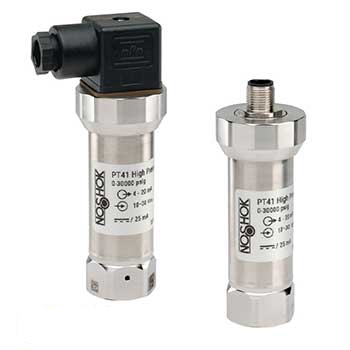
NOSHOK PT41 Series High Pressure Transmitters
Ranges from 23,000psig to 145,000 psig, picking up where gauge grade DIN 16001 pressures begin
 |
|

