





If you are viewing on a smaller screen or with screen zoom, please use the horizontal scroll bar at the bottom of this table to see all information.
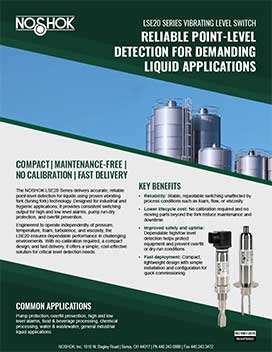
| SERIES | LSE20 | Vibrating level switch | ||
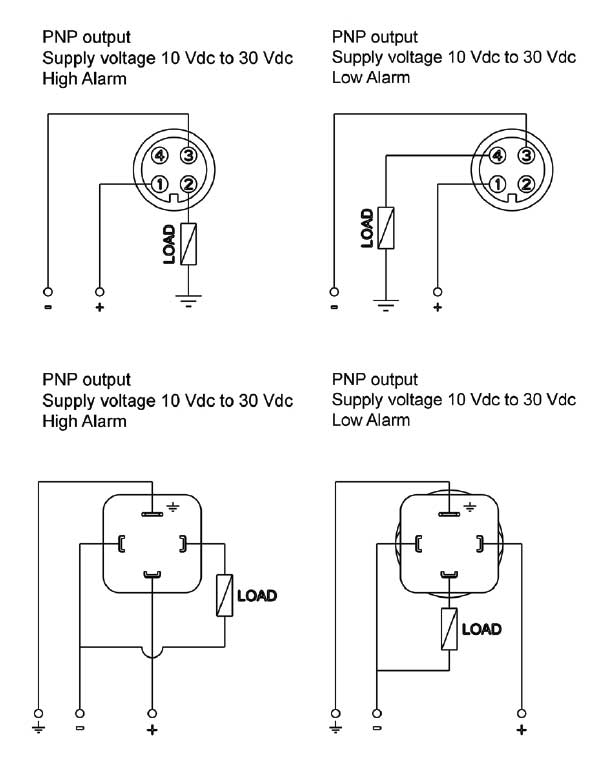
| OUTPUT SIGNALS | 1 | PNP/3-wire (Transistor PNP) | ||
| PROCESS CONNECTIONS* | 8 | 1/2" NPT male | 101 | 1-1/2" Tri-Clamp |
| 18 | 3/4" NPT male | 102 | 2" Tri-Clamp | |
| ELECTRICAL CONNECTIONS | 8 | DIN EN 175301-803 Form A | 25 | M12 x 1 (4-pin) |
*Other Connections Available, Consult Factory

If you are viewing on a smaller screen or with screen zoom, please use the horizontal scroll bar at the bottom of this table to see all information.
| SPECIFICATIONS | ||||||||||||||||
| Insertion length for industrial* | 3" | |||||||||||||||
| Insertion length for sanitary* | 2-3/8" | |||||||||||||||
| Switching output | PNP/3-wire (Transistor PNP) | |||||||||||||||
| Accuracy parameters: Switch point accuracy Switch hysteresis Repeatability Response time |
+/-0.08 inches (+/- 2 mm) ≤ 0.12 in (3 mm) 0.004 inches (0.1 mm) Covered by media - 0.5 seconds Uncovered by media - 1.0 seconds |
|||||||||||||||
| Density of media | 0.018 to 0.09 lbs/in³ (0.5 to 2.5 g/cm³) | |||||||||||||||
| Viscosity | 0.1 to 10,000 mPa s (0.1 to 10,000 cP) | |||||||||||||||
| Temperature ranges |
|
|||||||||||||||
| LED status | Green: Open Red: Closed Flashing Red: Error |
|||||||||||||||
| Power requirement** | 10 Vdc to 30 Vdc | |||||||||||||||
| Power consumtion | <1 W | |||||||||||||||
| Operating pressure | -15 psi to 930 psi | |||||||||||||||
| Housing material | 316L Stainless Steel | |||||||||||||||
| Wetted parts | 316L Stainless Steel, Optional: Hastelloy C-276 | |||||||||||||||
| Sanitary wetted parts | Ra < 30 uin (0.76 um) ASME BPE SF3 | |||||||||||||||
| Environmental rating | M12x1 (4-pin) - IP66/68 per IEC 60529, DIN - IP65 per IEC 60529 | |||||||||||||||
| Electromagnetic rating | RFI, EMI and ESD protection | |||||||||||||||
| Electrical protection | Protected against reverse polarity, over-voltage and short circuit | |||||||||||||||
| Weight | Approximately 7 oz. | |||||||||||||||
*Other lengths available, consult factory
** See user manual for detailed specifications

WARNING:This product can expose you to chemicals including Nickel, which is known to the State of California to cause cancer. For more information go to www.P65Warnings.ca.gov
A:
A level transmitter provides a continuous signal - typically 4?20 mA or 4?20 mA with HART® protocol - that represents the entire usable range of the tank. A level switch is a discrete instrument that simply changes state at a defined point, which is ideal for alarms and pump start/stop functions.
A:
Hydrostatic transmitters are ideal for continuous level measurement in wells, lift stations, and tanks where the media is relatively clean. Vibrating fork switches are excellent for high or low point-level protection and pump run-dry protection when you need simple binary level alarms. Radar level transmitters provide continuous, non-contact level measurement that excels in applications with varying dielectric properties, agitation, or where you want to avoid any wetted sensor in the tank.
A:
Level transmitters and switches ensure that a pump only operates when there is sufficient liquid present, preventing overheating, excessive wear, and potential cavitation caused by air ingestion. Early empty-pipe detection via continuous level monitoring or a point-level switch minimizes unplanned downtime and protects the pump.
A:
Start with the media (clean, viscous, foaming, or high solids), then consider pressure, temperature, hygiene requirements, and whether continuous measurement is needed or just high/low alarms. For example, many users pair a hydrostatic level transmitter for continuous control with a vibrating level switch for independent high level or dry run protection.
A:
Running a centrifugal pump with insufficient liquid leads to overheating, excessive wear, and potential seal failure. By using a level transmitter or a vibrating level switch near the suction point, you can shut the pump down before it ingests air.
A:
In food and beverage measurement, hygienic and sanitary are closely related but not always identical. Sanitary often implies conformity with specific regulations or standards such as 3-A or ASME-BPE clamp designs, while hygienic is a broader term describing designs that are cleanable, drainable, and resist product buildup. In practice, many engineers and OEMs use the terms interchangeably when referring to level and pressure instruments that feature polished stainless steel wetted surfaces, crevice free process connections, and CIP/SIP ready construction.
A:
A vibrating level switch is commonly installed at the minimum allowable liquid level in a supply tank, sump, or pipeline to provide a run-dry shutdown signal for the pump. It can also be mounted for high-level alarms or overfill prevention, using its configurable switching output for either high or low level conditions in a single compact device.
A:
To minimize false trips, use technologies designed for the environment, such as vibrating level switches whose resonant frequency changes only when the fork is actually immersed in liquid, keeping the switching point stable even as pressure, temperature, foam, or turbulence fluctuate. Tuning fork sensors are especially effective in viscous or coating liquids because the simple fork geometry and strong vibration help shed buildup, providing reliable high/low level trips and maintenance free performance in both industrial and sanitary CIP/SIP environments.
A: For large reservoirs and towers, NOSHOK non-contact radar level transmitters provide continuous level data without contacting the water, minimizing maintenance and contamination risk. Submersible transmitters can be used in wells and standpipes to track drawdown and recharge, supplying accurate data for storage management and distribution pressure control.