





A:
The choice between alternative o-ring elastomers is based on specific application parameters that primarily include chemical compatibility and temperatures. For example, FKM may be used on higher temperature applications, or applications that require a broader range of chemical resistance than EPDM.
A:
FKM (Viton®), PTFE (Teflon®) and Grafoil® are selected depending on the customer application. The customer will often designate what material is required for their application. This usually involves process parameters such as media, pressure, temperature and chemical compatibility. NOSHOK would not recommend any one material, but would be available to assist in the selection process.
A:
The choice between soft seat plastics, like o-ring elastomers, is application specific. Each plastic has its particular strengths depending on its wear resistance, chemical compatibility and heat resistance. Delrin® is a mid-range material with superior wear resistance and moderate heat and chemical resistance. PTCFE and PEEK are further up the performance range, but each increase in the range of properties has an associated increase in cost.
A: A regulating stem is typically a tapered stem for metering and flow control applications. Stem tips are often used for solid shut-off where high repetitions of opening and closing of the valve occur.
A: A one piece valve stem rotates and translates along its axis as it is being driven axially into the orifice. The rotational motion of the stem produces an undesirable amount of friction and galling against the sealing surface if not properly lubricated. A non-rotating stem tip rotates independently from the stem and stops rotating as it is driven axially against the orifice sealing surface while the stem continues its rotational and axial movement. A ball tip is a type of non-rotating tip that is used when metering and flow control is not required and a quick opening and closing of the orifice is needed. Ball tips require a few turns to fully open and close the orifice. The spherical surface of ball tips have the advantage of easily sealing an orifice that may be slightly misaligned because multiple tangential contacts available on its surface. Material selection is primarily based on wear life. Regulating hard tip stems have increased metering capabilities. The stem incorporates a fine pitched thread that requires additional turns to open and a specially design stem tip taper that allows for a slow and gradual opening of the orifice. This feature is often used on high pressure gases that may freeze upon expansion if the pressure drops too quickly.
A: Utilization of the 2070, 2170 and 3070 Series is a matter of customer preference. The extended series offers a longer version for applications where more clearance may be needed in an installation. The operation of a standard length and extended length valve are identical.
A: Frequently, customers specify a redundant isolation block valve for safety in critical applications. A double block and bleed configuration provides two isolation valves with a bleed in between to enhance isolation and safety.
A: Dielectric Kits are designed to maintain the integrity and reliability of the pipeline and piping system through safety and corrosion protection. Dielectric Kits provide a non-conductive barrier between the process piping and the instrument and isolate components from the effects of electrical current. By eliminating metal-to-metal contact, current is halted to prevent corrosion and aid in the cathodic protection of the system. NOSHOK offers a single piece design Dielectric Kit and a two-piece design consisting of a PTFE sealing gasket and PVC dielectric shim for when a separate sealing gasket or o-ring is required.
A: Stabilized Connectors are designed to reinforce the entire installation by shifting radial-stress load away from the NPT connections. These connectors are offered with an optional integral block valve, eliminating the potential of pressure shock to the measurement device. The NOSHOK stabilized connector with integral valve can be installed on either side of the stabilized body, allowing easy half-turn installation for a level mounting surface and eliminating potential leak paths.
A: Futbols, or flange adapters, bolt to the process side of a flange-flange manifold to allow connection of process flange taps or process root valves. Futbols also allow flanges to be connected to threaded process piping while maintaining the ease of removal or repair of the manifold if maintenance is required. The Futbols provide a 1/16 inch offset connection from the bolt holes to give connection centers of 2 inches, 2-1/8 inches or 2-1/4 inches.
A: Compression packing is a soft, pliant and resilient rope material, braided with various filaments or yarns, configured for inserting into a mechanical device such as a valve. A PTFE stem seal provides a seal between the shaft of the handle stem and the valve body. This seal is then compressed around the stem by means of a packing gland, which forms a watertight seal around the handle stem assembly. When used with compatible fluids, valves utilizing packing have a much higher pressure versus temperature rating.
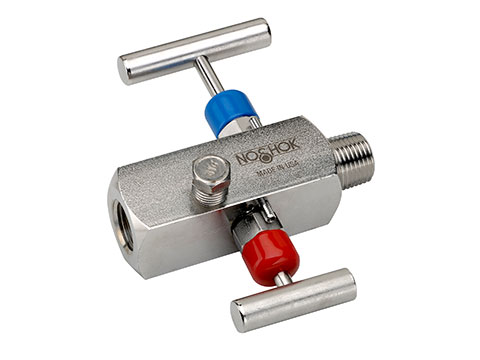
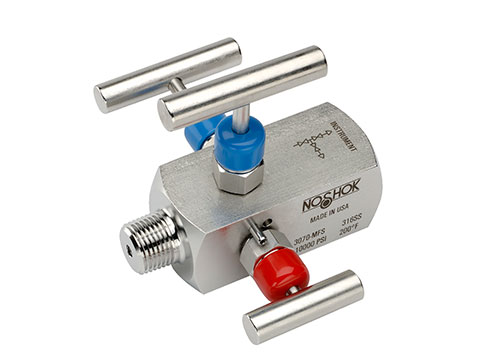
A: Block and bleed valves are traditional isolation valves, consisting of block and bleed (vent) needle valves to isolate and vent downstream pressure. Block and bleed valves are used to keep a system pressurized with a fluid or gas while venting pressure only from the process side.
A: Soft seat valves use a thermoplastic material such as PTFE or NBR, while hard seat valves use materials such as 316 stainless steel or Monel. The key advantage of hard seat valves over soft seat valves is that they can withstand high temperatures and harsh service conditions. In general applications, soft seat valves are suitable for use with clean fluids or gases and are not recommended for use with dirty or viscous fluids, as particulates may damage the soft seat material and cause leakage. If tight shut-off or bubble tight shut-off is required, a soft seat valve will provide superior sealing and shut-off capability in clean fluid applications. Hard seat valves can withstand extreme flashing, hydraulic shock, abrasive process fluid and ultra-high temperatures. In contaminated, erosive or corrosive fluid applications, a hard seat valve will provide better performance.